
TL;DR
NSCLC has become the primary battleground for antibody–drug conjugates (ADCs), combining scale, biomarker segmentation, and fast clinical readouts. While only three ADCs are approved—and all via accelerated pathways—the real competition is shifting to Phase 3 confirmation. The field is rapidly converging on Topoisomerase-I (Topo-I) payloads and TROP-2 targets, increasing crowding and competitive risk. Future winners will be defined less by innovation and more by execution: clinical positioning, safety management, and differentiation in an increasingly standardized landscape.
NSCLC Is Where ADC Strategy Gets Decided
Across the ADC landscape, NSCLC has become the primary proving ground—not merely because it is a high-incidence cancer, but because it offers the rare combination of scale, biomarker segmentation, and multiple late-line entry points that allow ADCs to generate rapid efficacy signals and pursue accelerated pathways. Our analysis shows three dynamics converging in NSCLC at once:
- Indication concentration: NSCLC attracts more ADC clinical activity than any other indication—exceeding the next two indications combined.
- A Phase 3 conversion race: NSCLC ADC approvals exist, but they remain accelerated only, turning Phase 3 execution into the strategic bottleneck.
- Payload convergence: The field is standardizing around Topoisomerase-I (Topo-I) payloads, while discontinued NSCLC ADC programs skew heavily toward tubulin inhibitors.
The implication is not simply “more programs.” It is that NSCLC is now a high-velocity, high-crowding arena where differentiation is increasingly defined by clinical positioning, safety management, and confirmatory strategy—not by novelty alone.
We started with the full ADC landscape—and NSCLC rises to the top
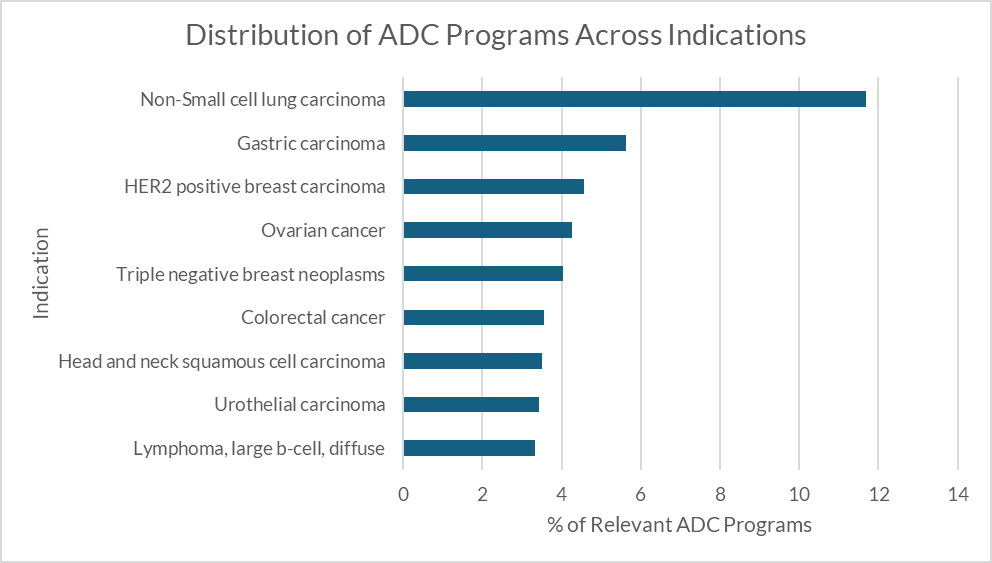
Before zooming into payloads and Phase 3 competition, we mapped where ADC development is actually concentrated. Across our oncology database, NSCLC is the single largest indication for ADC clinical programs, accounting for ~11.7% of relevant activity—more than the next two indications combined (gastric at ~5.6% and HER2-positive breast cancer at ~4.6%).
This concentration reflects where ADCs are uniquely positioned to deliver value:
- NSCLC has scale and segmentation. High incidence supports platform investment, while molecular subtypes (EGFR, HER2 mutations, MET expression, etc.) create multiple development lanes with different endpoints and competitive dynamics.
- Gastric remains high-need and difficult. Outcomes remain poor in many settings, and biomarker-defined subsets (e.g., HER2) support targeted payload delivery even as chemo-IO becomes standard.
- HER2-positive breast cancer is the ADC proof engine. It is one of the few markets where ADCs have already reset expectations, sustaining ongoing lifecycle and next-gen competition.
This is the strategic setup: NSCLC is where ADCs are being tested at scale, across multiple biomarkers, and under intense competitive pressure.
Only three ADCs are approved in NSCLC—and all are accelerated
Despite the program volume, NSCLC remains early in terms of regulatory maturity. Today, three ADCs are approved in NSCLC, all via accelerated approval:
- Enhertu (fam-trastuzumab deruxtecan-nxki) for HER2-mutant NSCLC (accelerated approval; 2022).
- Emrelis (telisotuzumab vedotin-tllv) for high c-MET protein overexpression NSCLC after prior systemic therapy (accelerated approval; 2025).
- Datroway (datopotamab deruxtecan-dlnk) for EGFR-mutated NSCLC after EGFR therapy and platinum chemotherapy (accelerated approval; 2025).
Why no regular approvals yet? The simplest explanation is timing. These are recent accelerated approvals (2022–2025), and conversion requires confirmatory outcomes that take time, particularly in earlier lines. For Enhertu, the key confirmatory program is DESTINY-Lung04, a Phase 3 first-line study; as of now, there has been no public top-line readout, and the trial listing still shows an estimated primary completion in late March 2026.
Strategically, this “accelerated-only” footprint signals that Phase 3 is the real bottleneck. NSCLC is no longer about proving ADC feasibility—it is about proving durability, survival impact, and manageability at scale.
The 2025 spike: NSCLC ADC development moved from momentum to land-grab
Our trendline shows NSCLC ADC initiations rising through the early 2020s—and then spiking sharply in 2025, reaching 71 new NSCLC ADC programs initiated that year alone.
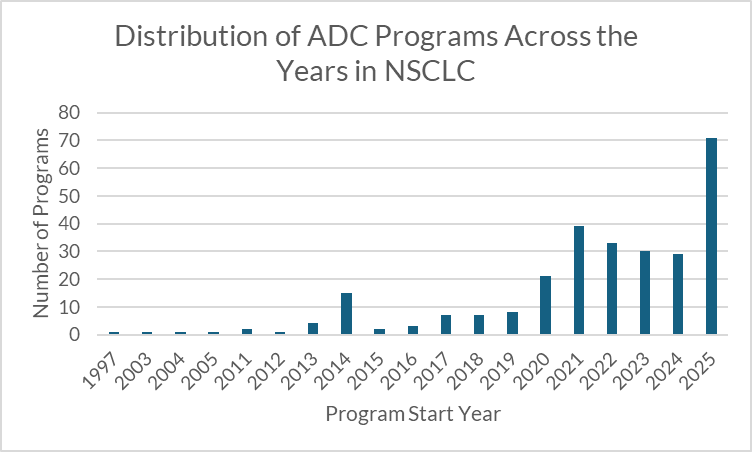
The most likely drivers are structural:
- Multiple approvals created urgency. With three accelerated approvals across distinct targets and biomarker settings, sponsors gained confidence that ADCs can work in NSCLC, but also saw that first-mover windows are closing.
- Late-line NSCLC is an efficient proving ground. Post-TKI and post-platinum settings support faster ORR/DoR readouts, enabling accelerated strategies and rapid iteration.
- ADC development has become more repeatable. Payload platforms, linker chemistry, and manufacturing playbooks have matured enough that starting a new ADC trial is operationally less exceptional than it was a decade ago.
This is why NSCLC now looks like a battleground: it has become a place where credible ADC success is possible, and therefore where competitive crowding accelerates fastest.
The payload pivot: tubulin dominated discontinued programs—Topo-I dominates what’s active now
A core signal in the dataset is the payload realignment:
- Among discontinued NSCLC ADC programs, ~70% used tubulin inhibitor payloads (microtubule inhibitors).
- Among currently active NSCLC ADC programs, ~73% use Topo-I payloads.
This is not simply fashion; it reflects the interplay between efficacy ceiling, safety tolerance, and competitive benchmarking.
Why tubulin payloads may have underperformed in NSCLC
Tubulin inhibitor payloads are potent and widely used historically, but they carry well-recognized toxicity risks and may be constrained by class-like tolerability ceilings—particularly in heavily pretreated solid-tumor populations. Reviews consistently note that ADC safety is often closely tied to payload class and linker stability, which can compress the therapeutic window.
In NSCLC—where many patients are older, comorbid, and exposed to prior systemic therapy—payload-driven tolerability can become the limiting factor even when targets are well selected.
Why Topo-I payloads have become the default
Topo-I ADCs—particularly deruxtecan-class constructs—have shown a strong combination of efficacy signal and platform repeatability, including linker/payload systems designed for intracellular release and bystander effect. Reviews of deruxtecan-powered ADCs describe how these design choices can contribute to therapeutic index and expand applicability across tumor contexts.
This does not eliminate risk (ILD/pneumonitis remains a central watch item), but it helps explain why Topo-I now anchors most active NSCLC ADC development.
Executive implication: NSCLC is moving into a Topo-I-crowded era. As payloads converge, differentiation shifts toward target selection, patient selection, line-of-therapy strategy, and safety management.
Targets: why TROP-2 leads—and why the rest follow
Our target distribution in NSCLC ADC programs shows a clear hierarchy:
TROP-2 (~29%), HER-3 (~20%), HGFR/c-MET (~11%), HER-2 (~10%), EGFR (~9%).
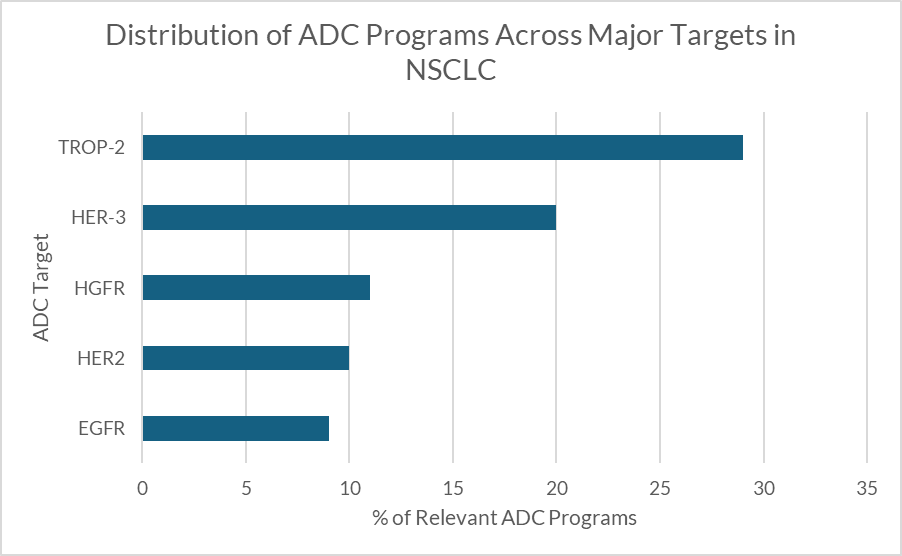
Why this mix makes strategic sense:
- TROP-2 is widely expressed across epithelial cancers (including NSCLC), supporting broad addressable populations and scalable labels. It also offers clear post-standard-therapy positioning logic, which is attractive for accelerated strategies. Reviews describe TROP-2 as overexpressed in many NSCLCs and a promising ADC target.
- HER-3 aligns with EGFR-mutant biology and resistance pathways, making it attractive in post-TKI settings where unmet need and sponsor interest are high.
- c-MET has now been operationally de-risked through defined enrichment approaches and accelerated approval precedent, which tends to catalyze follow-on development.
- HER-2 remains central because Enhertu validated HER2-mutant NSCLC as an ADC-addressable segment.
- EGFR remains central because it is one of the largest commercial NSCLC segments, and ADCs are increasingly being positioned as post-TKI solutions. Datroway’s accelerated approval reinforces this logic.
In practical terms, NSCLC ADC targets fall into two strategic groups: broad epithelial coverage (TROP-2) and biomarker-defined subsegments (EGFR/HER2/MET/HER3). Together, they maximize addressable population while preserving enrichment and differentiation pathways.
The pivotal race: TROP-2 + Topo-I dominates Phase 3—and the strongest outlier is already visible
Looking specifically at active Phase 3 NSCLC ADC trials, one pattern is unmistakable: Topo-I payload ADCs targeting TROP-2 dominate the pivotal pipeline, and nearly one-third list Datroway (datopotamab deruxtecan) as the primary drug.
This concentration is strategically predictable. Once a sponsor secures accelerated approval, the next move is to capitalize immediately—expand lines, expand populations, and build confirmatory evidence before competitors crowd the same setting. Datroway’s accelerated approval in EGFR-mutated NSCLC is therefore not an endpoint; it is a launchpad for label expansion and confirmatory positioning.
But this same pattern creates the category’s biggest strategic risk: if Phase 3 becomes dominated by TROP-2 + Topo-I, the question shifts from “can ADCs win in NSCLC?” to “how many versions of the same construct logic can win—and what will determine who does?” In that environment, the differentiators that matter are less about target novelty and more about:
- the sequencing story (where the drug sits relative to TKIs, chemo-IO, and other ADCs),
- safety and discontinuation management (especially payload-linked toxicities),
- endpoint strategy and comparator choices in confirmatory trials, and
- whether the sponsor can establish a coherent footprint before the class becomes indistinguishable.
Within that pivotal density, our PTRS (Probability of Technical and Regulatory Success) framework—built on historical outcomes, trial design patterns, and regulatory precedent—surfaces a clear Phase 3 standout: sacituzumab tirumotecan (sac-TMT / MK-2870 / SKB264).
Two external signals reinforce why it stands out:
- It targets TROP-2 and uses a Topo-I class payload, aligning with what appears to be the modern winning construct logic.
- The FDA granted Breakthrough Therapy Designation to sacituzumab tirumotecan for a defined NSCLC population (EGFR-mutated, post-TKI and platinum chemotherapy), signaling perceived promise in a high-need setting.
In an increasingly convergent Phase 3 field, assets combining strong early outcomes with regulatory designations tend to become strategic reference points—not just for sponsors, but for the entire competitive class.
What this means for strategy teams
NSCLC is now the ADC proving ground for three simultaneous battles:
- Accelerated approval → confirmatory conversion (with no regular NSCLC ADC approvals yet).
- Payload convergence (Topo-I dominance and class-level competitive risk).
- Target crowding (especially TROP-2 as the default broad-population target).
The near-term winners will not be determined only by target biology, but by who can execute Phase 3 with the right combination of population selection, sequencing strategy, safety management, and differentiation that clinicians and payers recognize.
How we support decision-makers in ADC strategy
Our benchmarking and analytics work supports teams navigating ADC competition with discipline:
- Clinical development leaders: We benchmark trial design, endpoint positioning, and phase progression patterns in NSCLC ADCs, highlighting where convergence increases risk and where differentiation is truly defensible.
- Portfolio strategists: We quantify momentum versus maturity—separating durable trends (Topo-I adoption, TROP-2 concentration) from crowded bursts—and help prioritize where success probability is structurally higher.
- BD and licensing teams: We contextualize assets against the live competitive map (targets, payload classes, lines of therapy, Phase 3 density), supporting faster diligence and more realistic valuation.
Bottom line: NSCLC is where ADCs are being industrialized—and Topo-I is becoming the default. The next differentiator will be who can win Phase 3 without becoming another point on an overcrowded curve.
For more tailored, data-rich insights, let’s talk.