
TL;DR
BiTEs have evolved from experimental immunotherapy to a validated oncology modality post-2014. While myeloma (BCMA) remains the dominant application, GPRC5D is emerging as a potential next target. Solid tumor progress is limited but selective (notably SCLC and prostate), and immunology applications are still early-stage. The field is shifting from validation to competitive target selection under increasing crowding.
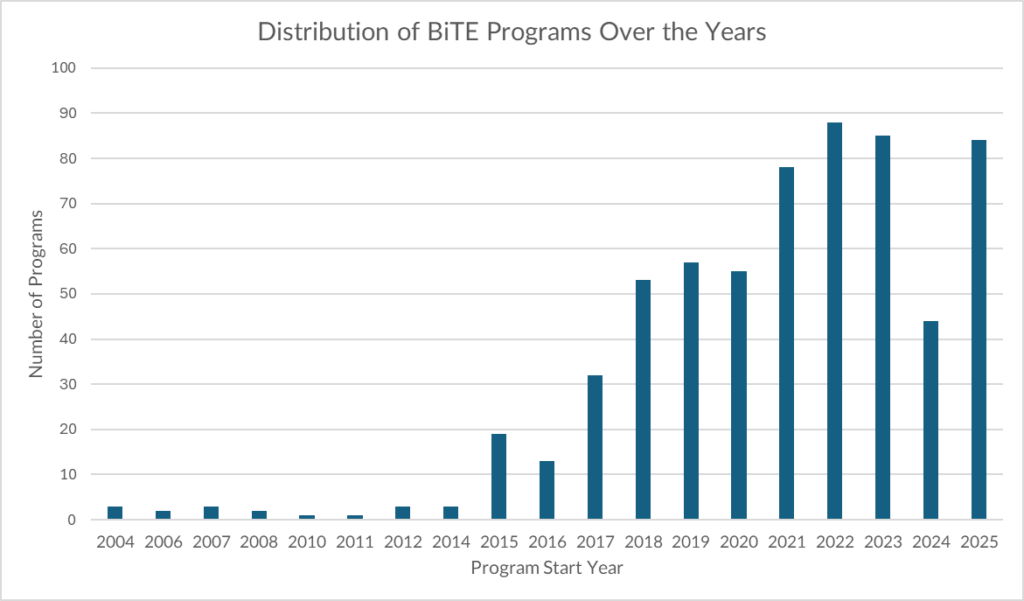
The post-2015 initiation trend reflects sustained expansion in BiTE development following early regulatory precedent. 2024 shows a temporary deviation and should be interpreted cautiously as a probable outlier year.
From concept to category: why BiTEs suddenly became “real”
Bispecific T-cell engagers (often grouped under “BiTEs,” though the term is also a specific platform trademark) have existed conceptually since the early 2000s, but they remained a niche approach until a clear regulatory proof point arrived. That proof point was blinatumomab (Blincyto)—a CD19×CD3 T-cell engager that received FDA accelerated approval on December 3, 2014.
The 2015 inflection in program initiations is therefore not surprising: Blincyto provided what the field needed most—precedent. It validated three things simultaneously:
- the clinical viability of redirecting T cells with an “off-the-shelf” biologic,
- an approvable development pathway built around measurable disease and response endpoints, and
- a commercial narrative distinct from checkpoint inhibitors and conventional antibodies.
BiTEs did not become “easy” after 2014, but they became investable. The growth curve that follows is best read as a market learning how to scale a newly validated mechanism class.
Approvals: still a hematology engine—with one solid-tumor proof point
The approval footprint remains dominated by hematologic malignancies, where target accessibility and measurable responses make development more tractable. However, it is no longer accurate to say the modality is “liquid only.” Small cell lung cancer (SCLC) is a solid tumor (a lung neuroendocrine carcinoma), and it has become the most prominent solid-tumor validation point for the broader T-cell engager category.
In May 2024, the FDA granted accelerated approval to tarlatamab-dlle (Imdelltra) for extensive-stage SCLC. This matters because it shows that engager biology can translate beyond hematologic settings—yet it also reinforces how selective solid-tumor success remains: one high-profile exception does not constitute platform generalization.
Why myeloma dominates: the modality’s “perfect storm” indication
The outsized concentration of BiTE activity in multiple myeloma is structural, not accidental. Myeloma offers an unusually favorable mix for T-cell engager development:
- Target density and biological relevance: antigens like BCMA and GPRC5D map directly onto malignant plasma cells.
- Measurable disease and faster signals: response endpoints, depth-of-response, and progression readouts can emerge more rapidly than in many solid tumors.
- Multiple lines of therapy: relapsed/refractory sequencing creates repeated entry points for clinical differentiation and regulatory strategy.
- A validated antigen blueprint: BCMA was clinically de-risked across modalities, making BCMA×CD3 a natural first wave for engager developers.
In effect, myeloma provides both a mechanistic rationale and a practical development environment. Once sponsors believe an efficacy story is reproducible, the space attracts iterative waves of “format innovation” and competitor follow-ons.
The BCMA question: why the market is probing beyond it—and why it’s not yet a rotation
Within myeloma, the BCMA×CD3 landscape is now crowded enough that the strategic question has shifted from “does BCMA work?” to “what comes after BCMA?” There are several pragmatic drivers behind the move to explore other myeloma targets:
- Post-BCMA patient reality: as BCMA therapies proliferate (across CAR-T and antibodies), a growing fraction of patients will enter subsequent lines with prior BCMA exposure, forcing sponsors to consider second-target pathways as a commercial necessity rather than a scientific curiosity.
- Resistance and antigen dynamics: even without fully mapping escape mechanisms, developers are acting on the reasonable assumption that deep and repeated targeting pressure will create populations where BCMA-centric strategies underperform.
- Crowding and differentiation: in a field where multiple BCMA-targeting constructs exist, it becomes harder to justify another BCMA×CD3 unless the format or clinical profile is clearly superior.
This is where GPRC5D emerges. It has become a prominent “next target” candidate in myeloma—not because BCMA is failing broadly, but because the market anticipates a sequencing problem. In that context, the movement to GPRC5D should be read as portfolio hedging and future-proofing.
A concrete signal supporting sponsor belief is that the FDA granted Fast Track designation to LBL-034 (GPRC5D×CD3) for relapsed/refractory myeloma in January 2026.
However, despite this momentum, the data still suggests “testing the waters” rather than a wholesale rotation: BCMA remains the dominant myeloma engager target, and non-BCMA approaches have not yet achieved a critical mass that would indicate a platform-level shift. Only around 10% of the currently active BiTE programs in myeloma focus on GPRC5D.
Targets: CD3 is the invariant—everything else is strategic choice
Across the BiTE landscape, one pattern is nearly universal: CD3 is the common denominator, because it is the recruiting handle that activates and redirects T cells. The second target is where strategy becomes visible—signaling which biology, patient-selection logic, and endpoint feasibility sponsors believe in.
- In hematologic malignancies, the most common second targets remain CD19 and CD20, reflecting decades of validated biology, established clinical workflow, and target accessibility in B-cell malignancies. These pairings also tend to align with faster response readouts and clearer regulatory narratives.
- In myeloma specifically, the second target has historically been BCMA, which remains the anchor. GPRC5D is now the most visible “second wave” myeloma target, but it is still fundamentally part of the liquid cancer success engine—not a solid-tumor story.
- In solid tumors, the second target list narrows to antigens that can plausibly support tumor selectivity and manageable on-target/off-tumor effects. In our dataset, EGFR and PSMA stand out in this category. Their appeal is understandable: EGFR is biologically relevant across multiple epithelial tumors, while PSMA offers a well-established “targetable ecosystem” in prostate (including imaging and theranostic precedent).
A useful way to summarize the current era: CD3 has become standardized, and the second antigen is where programs reveal whether they are incrementally competitive or genuinely differentiated.
Solid tumors: progress is real, but still highly selective
Solid tumor translation remains the principal bottleneck for BiTE-style approaches. The reasons are well known: target heterogeneity, immunosuppressive microenvironments, and the challenge of achieving sufficient tumor engagement without unacceptable systemic toxicity.
Even so, our dataset indicates that three solid-tumor assets have reached Phase 3, which is itself meaningful in a category where most programs do not survive long enough to justify pivotal scale.
Two of the most visible Phase 3-stage solid-tumor programs include:
- Xaluritamig (STEAP1×CD3) in metastatic castration-resistant prostate cancer (mCRPC), currently listed in Phase 3 on ClinicalTrials.gov.
- Pasritamig (a prostate-focused T-cell engager program), which has publicly reported early clinical activity and has advanced development consistent with late-stage intent.
The strategic takeaway is not that solid tumors are “solved,” but that the pathway is narrowing toward a small number of antigens and indications where target biology and operational feasibility can coexist. Prostate is a natural early landing zone because it supports biomarker-driven identification and has a history of targeted modality adoption. Colorectal and other epithelial tumors are more challenging, and success there will require tighter target logic and more refined toxicity management.
Beyond oncology: early branching, still pre-pivotal, but strategically coherent
While oncology—and especially hematology—remains the center of gravity, our dataset shows early development activity in immunology and a minimal footprint in CNS.
Immunology: early momentum in lupus and rheumatoid arthritis
Since 2022, BiTE development in immunology has progressed meaningfully, reaching 20 total clinical programs, with 2 discontinued and the remainder still active. None have reached Phase 3. This is not a mature trend yet, but it is a signal: sponsors are exploring whether “redirected cytotoxicity” can be applied beyond cancer into diseases where pathogenic immune populations drive damage.
The focus on lupus and rheumatoid arthritis is strategically coherent:
- Both diseases have a strong B-cell and autoantibody dimension in at least subsets of patients.
- Prior success of B-cell targeting approaches primes sponsor interest in deeper depletion strategies.
- There is persistent unmet need in refractory populations, where risk tolerance may be higher if benefit is durable.
In immunology, the target landscape is notably concentrated: the dominant pairings are CD3×CD20 (and, more broadly, CD3 with B-cell lineage targets). That makes sense: CD20 is already established in autoimmune disease care pathways, and pairing it with CD3 is essentially an attempt to convert “depletion” into a stronger, possibly more durable immune reset. The constraints are equally clear: immune activation risk, cytokine-release management, and long-term safety tolerance will determine whether these programs can ever justify pivotal investment.
CNS: a single program in myasthenia gravis—why it makes sense
Our dataset identifies a single CNS-associated program in myasthenia gravis targeting CD3 and BCMA. While myasthenia gravis is not traditionally framed as a CNS disease in the same way as neurodegeneration, it is an antibody-mediated neuromuscular autoimmune condition—making BCMA conceptually relevant because BCMA biology is linked to plasma cells, which can contribute to pathogenic autoantibody production. Published scientific discussion of BCMA-targeting approaches in myasthenia supports why sponsors might test this axis in severe disease.
The key point: non-oncology BiTE development is no longer nonexistent, but it remains early, highly concentrated, and pre-pivotal—more hypothesis exploration than established modality expansion.
What to watch next
The next phase of the BiTE story will be determined by whether the category can expand without losing its core advantage—measurable efficacy and definable patient selection.
- In myeloma, the key question is whether GPRC5D and other non-BCMA targets become genuine second-wave standards or remain niche hedges.
- In solid tumors, the key question is whether Phase 3 programs establish repeatable safety/efficacy patterns and unlock additional target classes beyond the current narrow set.
- In immunology, the key question is whether benefit can be demonstrated with an acceptable safety profile for chronic disease populations—enough to justify Phase 3-scale investment.
How we support decision-makers in BiTE strategy
Our benchmarking and analytics work helps teams navigate mechanisms that are simultaneously high-momentum and high-crowding:
- Clinical development leaders use our evidence frameworks to benchmark where BiTE programs succeed by indication and target pairing, and to pressure-test whether a program’s design is differentiated enough to justify late-stage risk.
- Portfolio strategists rely on our landscape analytics to quantify where growth reflects durable platform adoption versus saturation, and to identify where “next target” narratives are real versus performative.
- BD and licensing teams use our comparative context to evaluate whether an asset sits in a crowded BCMA lane, a credible second-wave myeloma target lane, or a higher-risk solid-tumor expansion lane—with clear implications for valuation and deal structure.
BiTEs are no longer a novelty class. The strategic question is whether the next wave is driven by better biology—or simply more constructs.
For more tailored, data-rich insights, let’s talk.